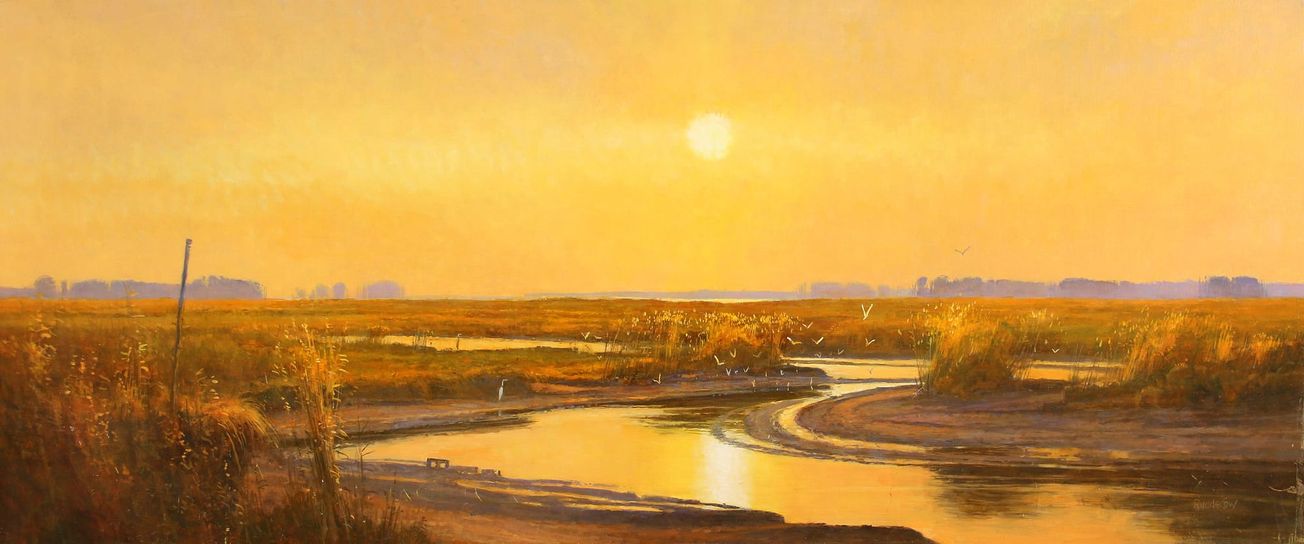
Once, situated along the Delaware Bay in Down Township, New Jersey, stood a small community of homes known as Gandy’s Beach. It was named after the sea captain James Gandy, who had a strong connection to the oyster industry. Artist Glenn Rudderow moved to Gandy’s Beach in 1977, before relocating to the historic village of Dividing Creek, and then eventually to Hopewell Township. It is during this time that Glenn immersed himself in the wetland environment. For many, these locations are far too remote for living, always at risk of nature’s fury. Glenn not only preserved the ever-changing environments with his paintings, but also faithfully recorded his thoughts in his detailed journals. After reading his journals, living in Gandy’s Beach felt like episodes of Deadliest Catch, but on land. “Storm from the South, January 25,26,27, 1978, a severe storm from the south hit Delaware Bay coastal areas. Waves 8 feet and higher hitting the beach directly – foam and splash going higher than houses. Money Island and G.B roads were directly hit by waves.” Only a week later, “February 6th – Severe snow storm /blizzard.” One of the most severe winter storms that hit the Northeast was the blizzard of ’78, which dropped over two feet of snow. The storm lasted three days and caused major disruptions across the region. Today, Gandy’s Beach is a preserve with closures during peak shorebird migration in May and June, but the battle against nature continues.
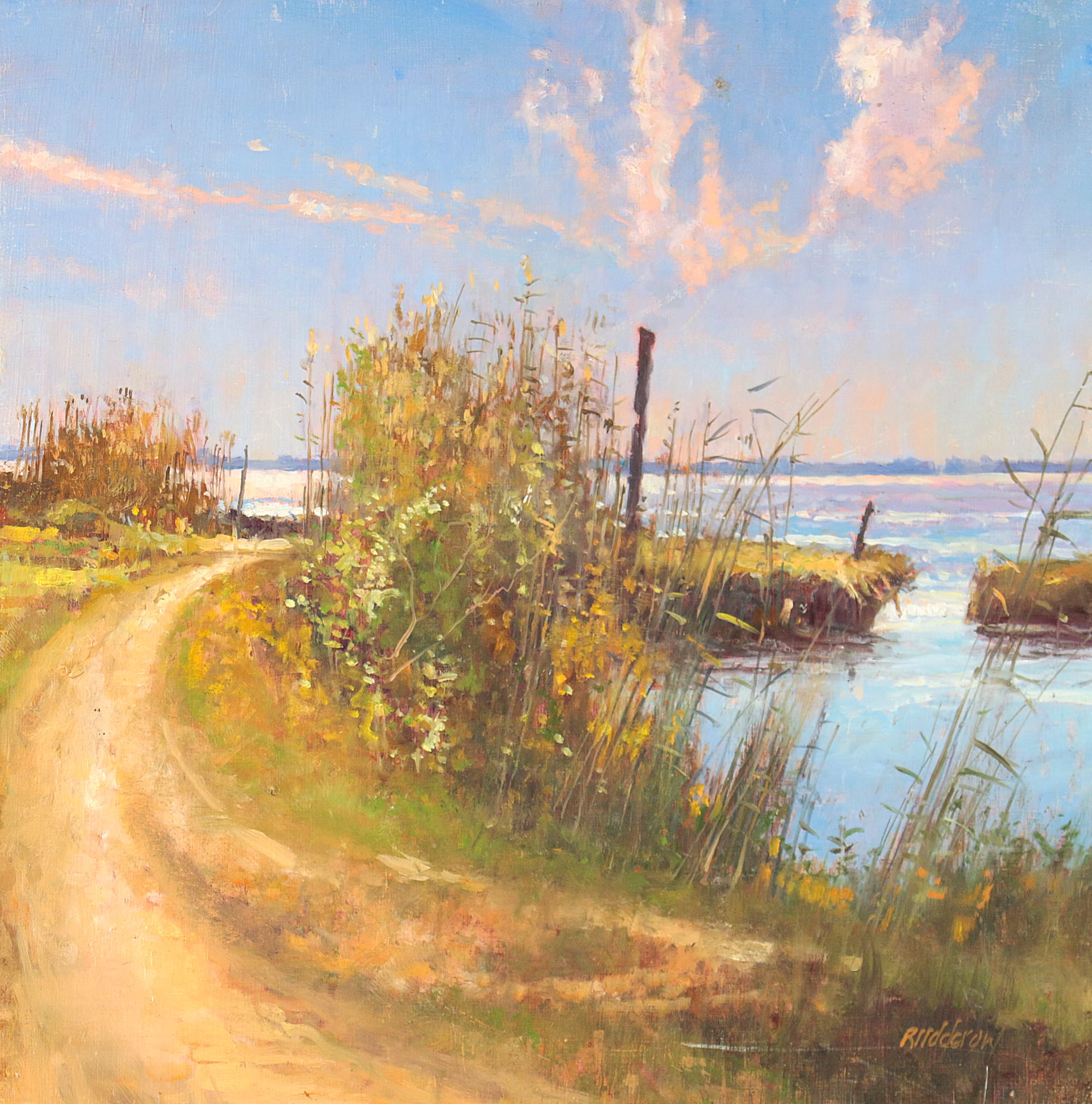
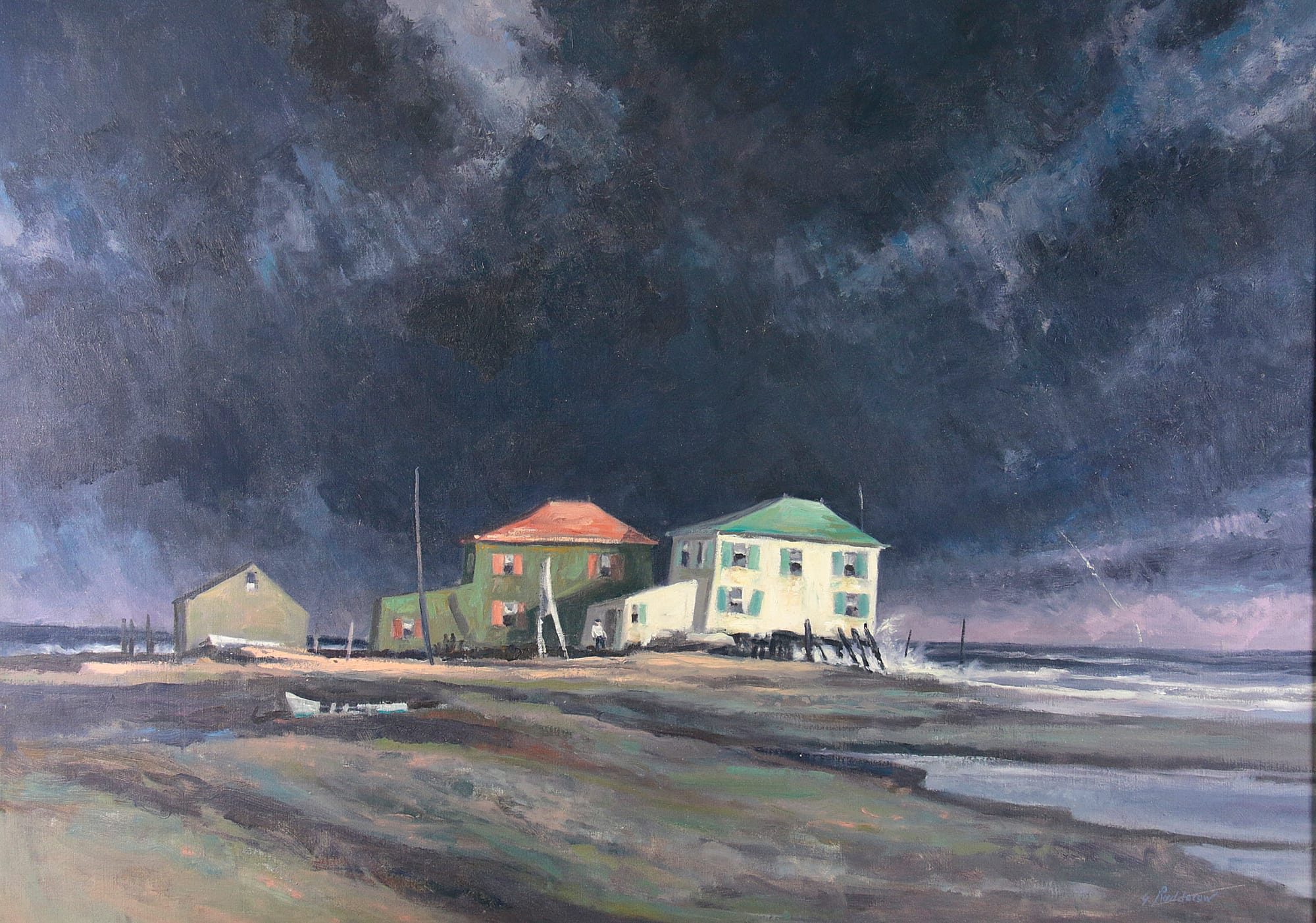
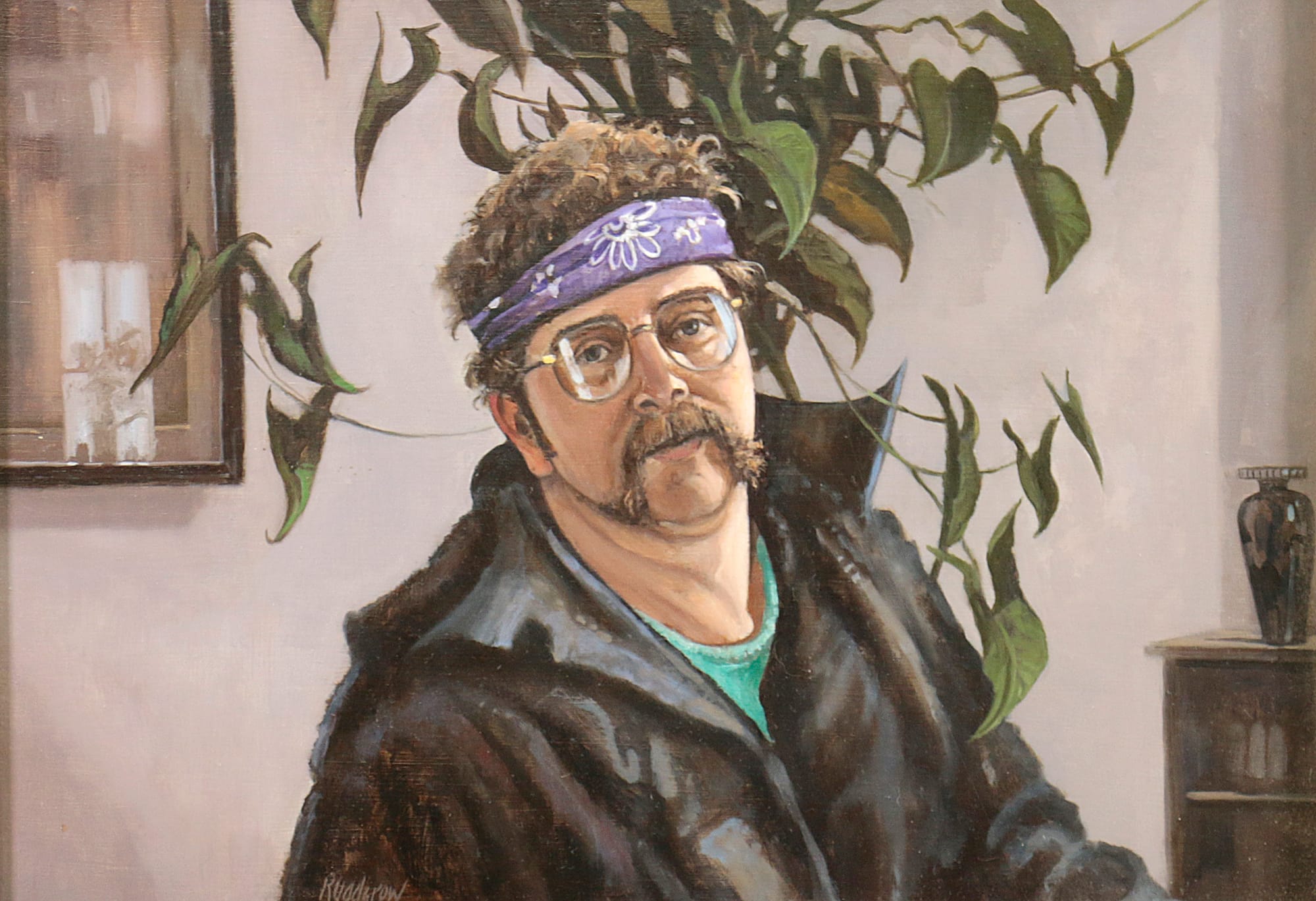
From left to right: Cavier Inlet, Gandy's Beach, Self Portrait
For decades, Glenn has been interpreting the Delaware Bayshore, capturing the spirit and light of the wetlands. His paintings have revealed the early-morning mist rising from the marshes, light reflecting off the tidal waters, and the quiet farmhouses resting across the land. Born in Chicago in 1953, Glenn came to New Jersey and immersed himself in the arts. First studying at the Barn Studio of Art in Millville with Pat Witt, followed by the Pennsylvania Academy of the Fine Arts (1972–1976). The Academy is known as one of the oldest art academies in the United States, with a strong tradition of realist painting. These two institutions grounded him in observational drawing and landscape study. Among many of his key influences were Louis Sloan, Ben Kamihira, and Morris Blackburn. In 1986, Glenn began to teach at the Academy. “In teaching, I always felt that a teacher’s greatest gift to the student was to be able to learn as much from the student as the student did from the teacher…My goal was always to present teaching as a friend relaying information to another friend. And I strongly believe that as long as I talk, I hope that I will learn as much in teaching as the students were learning from me as students.”
As a visual poet, Glenn chose to live within the landscapes he painted. It was through this immersion that he was able to paint the region with deep familiarity. Like many of the masters, Glenn would paint the same subject matter throughout the changing seasons, reflecting on the cycles of nature and the interplay of land, water, and light. There is a harmony created through his brushstrokes that reveals the Bayshore's hidden emotional and spiritual qualities. Throughout his career, Glenn received national recognition through major juried exhibitions at institutions such as the Pennsylvania Academy of the Fine Arts, the National Academy of Design, the American Watercolor Society, the Butler Institute of American Art, the Woodmere Art Museum, and the Noyes Museum of Art.
Glenn states, “My paintings reflect the cycle of the seasons, the forever changing light, the harmonies sung by plants, animals, and insects in their interactions with water, land, and air. I try to capture the feelings that suggest the lives and spirits of the people who move through these harmonies. It is my desire to create statements that convey my passion and obsession for these things. To paraphrase N. C. Wyeth, one can only paint that which one knows more than intimately; one has to know it spiritually.” This past year, my friend Glenn passed away, but through his paintings, he recorded a living ecosystem while preserving a cultural landscape. Through decades of observation and devotion to place, Glenn has become the visual historian of the Delaware Bayshore. A retrospective of his work, A Life in Art: Glenn Rudderow, will be on exhibit at Rowan College’s Arts and Innovation Center from May 15th through July 20th.
For more information about Glenn and to purchase his work, please visit https://glennrudderow.com